
There was a time when you could order an entire house…
From a catalog.
Not a couch. Not a table.
Not a “some assembly required” bookshelf that somehow takes three hours and a mild identity crisis to put together.
A house.
Delivered in pieces.
With instructions.
And the expectation that you—or someone you knew—could figure it out.
Early 1900s homeownership met logistics, ambition, and just enough confidence to say:
“Yes, I think we can build this ourselves.”
Welcome to the world of mail-order houses.
Wait… You Could Really Order a House?
Yes.
You absolutely could.
Between the early 1900s and the 1940s, companies like Sears, Roebuck & Co. sold complete house kits through mail-order catalogs.
These weren’t vague plans or inspiration guides.
They were:
- fully designed homes
- shipped as pre-cut materials
- labeled and organized
- accompanied by detailed instructions
Customers would:
- Choose a home design from a catalog
- Place an order
- Receive everything needed (lumber, nails, windows, doors, etc.)
- Build the house on their property
Which raises a very reasonable question:
How did this actually work?
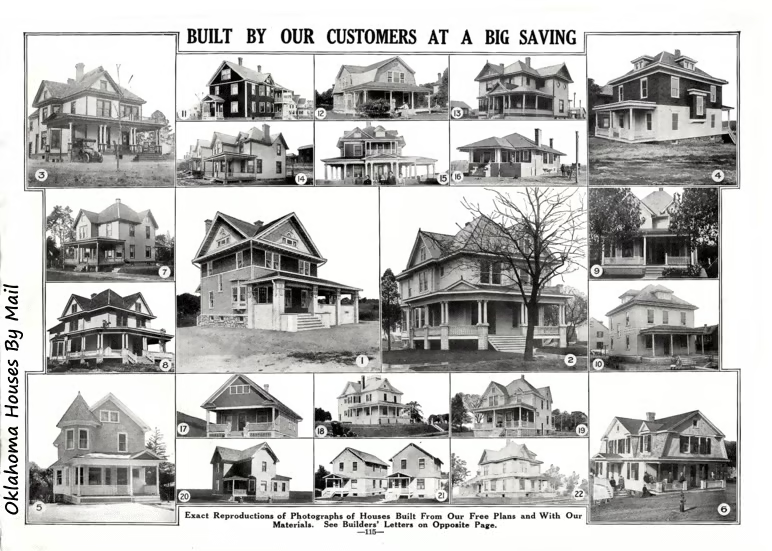
Step One: Delivery (Hope You Like Trains)
Once ordered, the house materials were shipped—often by rail—to the nearest train station.
From there:
- materials were unloaded
- transported to the building site
- sorted and organized
A typical kit could include thousands of individual pieces.
Which meant delivery day wasn’t:
“Your package has arrived.”
It was:
“Your entire future home is now sitting in pieces and we trust you to handle it.”
Step Two: Assembly (Confidence Required)
Here’s where things get impressive.
These homes were designed to be built by:
- homeowners
- local builders
- small crews
Materials were:
- pre-cut
- pre-measured
- labeled to match instructions
Which made construction more accessible than traditional homebuilding.
In many cases, this system reduced:
- construction time
- material waste
- overall cost
And while it still required skill, it didn’t require starting from scratch.
Which, for many families, made homeownership possible in a way it hadn’t been before.

Why Mail-Order Houses Became So Popular
Mail-order homes didn’t succeed just because they were novel.
They solved real problems.
Affordability
Buying materials in bulk reduced costs.
Accessibility
People in rural or developing areas could access home designs and materials.
Simplicity
Pre-cut pieces meant less guesswork during construction.
Choice
Catalogs offered a wide range of styles—from small cottages to large, multi-story homes.
At a time when communities were growing and expanding, this model fit perfectly.
Especially in areas where:
- local resources were limited
- skilled labor was harder to find
- families were building literally from the ground up
The Original “Some Assembly Required”
It’s hard not to compare mail-order homes to modern flat-pack furniture.
Because the concept is surprisingly similar:
- everything arrives in pieces
- instructions are included
- success depends on interpretation
The main difference?
The stakes.
Because if you misread a step while assembling a bookshelf…
You get a wobbly shelf.
If you misread a step while building a house…
There may be a slightly bigger concern….
This same mix of practicality and creativity shows up in other parts of daily life too—like [#86 Iceboxes, Ice Men, and the Battle Against Spoiled Milk] and [#84 Wash Day Wednesdays: The Most Exhausting Day of the Week], where households constantly adapted to the tools they had.
More Than Just Houses
Mail-order homes weren’t just buildings.
They represented something bigger: Opportunity.
For many families, owning a home meant:
- stability
- independence
- long-term investment
- a place to build a life
- The American Dream
And the fact that these homes could be ordered and assembled made that opportunity more reachable.
Especially for:
- working-class families
- rural communities
- first-time homeowners
It turned the idea of:
“We’d like a home someday”
into:
“We can build one now.”
What Genealogists Can Learn from Mail-Order Homes
Mail-order houses are surprisingly useful in family history research.
They can help you:
Identify Homes
Some houses still standing today can be traced back to specific catalog models.
Understand Location Choices
Rail access often influenced where homes could be delivered and built.
Evaluate Economic Status
Owning a mail-order home could indicate a certain level of financial stability.
Track Migration
As families moved west or into developing areas, these homes often followed.
Which means your ancestor’s home might not just be a place they lived
But part of a larger story about:
- opportunity
- growth
- change

Somewhere Between the Catalog and the Life Built Inside
What I find most interesting about mail-order homes isn’t just the concept.
(It’s already a little wild.)
It’s what came after.
Because once the house was built, it became:
- the place where meals were shared
- where wash days happened
- where Sunday dinners were hosted
- where visiting cards were received
- where everyday life unfolded
The structure came from a catalog.
But everything that mattered happened inside.
Final Thoughts
Mail-order houses may sound unusual today.
But they were a practical solution to a real need.
They combined:
- innovation
- accessibility
- and just enough optimism
to make something big feel possible.
There’s something kind of incredible about that.
Even if I personally would like slightly more guidance than an instruction booklet before attempting to assemble an entire house.
🔗 Related Rabbit Holes
- [#86 Iceboxes, Ice Men, and the Battle Against Spoiled Milk]
- [#84 Wash Day Wednesdays: The Most Exhausting Day of the Week]
- [#108 The Sunday Dinner: When Meals Were Family Reunions]
- [#101 Small-Town Gossip Columns: When Everyone’s Business Made the Paper]
📚 Sources & Further Reading
- Sears Catalog Homes: Overview, History & Present Day
- The Rise and Fall of the Mail-Order Home
- Smithsonian Institution — American housing and consumer history
- Library of Congress — early 20th-century housing and development
- Sears, Roebuck and Company — mail-order catalog home kits
- Historical archives of Sears Modern Homes catalogs