
Genealogy research has a very specific danger zone.
You sit down with a simple goal. Just one.
Maybe:
“Find the 1900 census record for Great-Grandpa John.”
Reasonable. Straight-Forward. Focused.
Then, somehow, fifty-seven minutes later, you are researching a neighbor’s second wife’s brother because his surname looked familiar, and maybe he witnessed a marriage record, and possibly there was a land dispute, and now you have twelve tabs open.
The 1900 census? Still missing.
Your original goal? Abandoned in the woods.
Your brain? Fully convinced this detour is important.
This is why every genealogist needs a Rabbit Hole Parking Lot.
A Rabbit Hole Parking Lot (also commonly but less entertainingly known as a “Research Parking Lot”) is a place to quickly capture tempting genealogy side quests without chasing them immediately. It lets you write down the clue, save the thought, and return to your original research goal before your entire afternoon becomes a historical scavenger hunt sponsored by chaos.
The point is not to ignore rabbit holes forever.
Absolutely not. Some rabbit holes turn into the best discoveries.
The point is to park them until it is actually their turn. Because there is a time and place to go down the rabbit hole.
Just maybe not while you are supposed to be finding one census record.

What Is a Rabbit Hole Parking Lot?
A Rabbit Hole Parking Lot is a simple research tool for capturing distracting genealogy ideas. It is where you put clues that are interesting, suspicious, possibly useful, or deeply tempting — but not part of your current research goal.
It can be a:
- printable worksheet
- notebook page
- Google Sheet
- spreadsheet tab
- section in your research log
- page in your genealogy binder
- notes app list
- digital document
- sticky note system
The format matters less than the habit.
The habit is:
- Notice the side quest.
- Write it down.
- Return to the main goal.
Very simple. Emotionally difficult. Because genealogy side quests are persuasive.
They whisper things like:
“This will only take five minutes.”
They are lying.
For some research tips, check out 10 Things to Make Your Genealogy Research Easier.
Why Use a Rabbit Hole Parking Lot?
A Rabbit Hole Parking Lot helps you stay focused without losing good ideas.
That is the magic of it.
You are not telling yourself: “Ignore this forever.”
You are telling yourself: “This might matter, but not right this second.”
That tiny difference matters.
A parking lot helps you:
- stay focused during research sessions
- avoid losing interesting clues
- stop opening endless tabs
- capture side questions
- separate current goals from future research
- prevent duplicate searches
- build a future research list
- protect your original research question
- save ideas for family stories or worksheets
- reduce overwhelm
It is especially useful if your brain likes connections. Because genealogy is full of connections.
Names repeat. Neighbors reappear. Witnesses look familiar. Counties change. Cousins marry cousins. Someone’s obituary mentions a place you have never seen before.
And suddenly your carefully planned research session becomes:
“What was life like in this county in 1863 and why does everyone know a man named Samuel?”
A Rabbit Hole Parking Lot lets you save that thought without letting it drive.
For what information to include in your current research log, check out What to Include in a Genealogy Research Log.
When Should You Use a Rabbit Hole Parking Lot?
Use it whenever you are researching and a tempting side clue appears.
Examples:
- You see an unfamiliar surname next door in the census.
- A witness on a marriage record has the same surname as your ancestor.
- An obituary mentions a sibling you did not know existed.
- A newspaper article references a strange event.
- A cemetery plot includes someone unexpected.
- A family story mentions a town, object, job, or feud.
- A DNA match points to a possible branch you are not ready to investigate.
- A record hints at a second marriage.
- A name variation appears.
- You suddenly want to research an entire county history instead of your actual person.
All valid. All potentially useful. Not all urgent.
That is the key.
A Rabbit Hole Parking Lot is especially helpful during:
- short research sessions
- family interviews
- cemetery visits
- census analysis
- newspaper searching
- record review
- source cleanup
- timeline building
- blog planning
- genealogy reset days
It is also useful when you are tired. Because a tired genealogy brain will absolutely convince you that now is the perfect time to investigate the entire neighboring family who moved from Virginia to Ohio.
It is not.
Drink water. Park the clue.
What to Include in a Rabbit Hole Parking Lot
A good Rabbit Hole Parking Lot does not need to be complicated.
The goal is to capture enough information that future-you can understand the clue later. Because future-you will not remember why “check Henderson???” mattered.
Future-you will simply stare at it and feel betrayed.
Here are the most useful sections.
1. Interesting Clue
Start with the clue itself.
What caught your attention?
Examples:
- “Neighbor family named Bennett appears next to Clara in 1880 census.”
- “Marriage witness was Samuel Whitmore.”
- “Obituary mentions brother living in Kansas.”
- “Possible maiden name: Ellen Morris?”
- “Born in Belfast, Maine? Family lived in nearby town.”
- “Mysterious newspaper clipping about J.H. Allen in 1892.”
- “Same-name issue: Which John Smith is this?”
- “Civil War clue: Co. K, 12th Maine Infantry on pension record.”
- “Possible second wife listed in 1910 census.”
- “Same surname appears in cemetery plot.”
Write enough detail to jog your memory.
Not:
“weird census thing”
Better:
“1880 census: unknown 12-year-old Martha Bennett living with James and Clara; check relationship.”
Specificity saves lives. Genealogy lives.
Still counts.
2. Where I Found It
Always record where the clue came from.
This might include:
- website address
- record collection
- census year
- newspaper title
- page number
- image number
- cemetery name
- interview date
- person who told you
- book title
- archive
- file name
- screenshot location
This is one of the most important fields.
Because a clue without a location is basically a historical ghost. Interesting, but difficult to work with.
Examples:
1900 U.S. Federal Census, Franklin County, Kansas, Robert Ellis household, page 12B.
Interview with Aunt Linda, Thanksgiving 2025.
Find a Grave memorial for Clara Bennett, Ogden City Cemetery.
You do not need a perfect citation in the parking lot, but you do need enough information to find the clue again.
How to Organize Your Digital Files
3. Why It Might Matter
This is the field that saves future-you from confusion.
Write why the clue caught your attention.
Examples:
- “May identify Clara’s brother.”
- “Could explain migration from Missouri to Kansas.”
- “Possible maiden-name clue.”
- “May separate two John Parkers.”
- “Could lead to obituary.”
- “Neighbor surname repeats in two census years.”
- “Might connect to family story.”
- “Possible clue for unknown parents.”
- “Could become a family history book chapter about family cow story.”
- “May explain missing child between census years.”
This does not need to be long. One sentence is enough. But do not skip it!
Because future-you may not remember the logic.
Past-you tends to think:
“Obviously I’ll remember why this matters.”
Past-you is adorable.
Wrong, but adorable.

4. Come Back to This Later
The attached example includes a “Come Back To This Later” column, and I love that.
It is simple. It is visual. It is basically a tiny agreement with myself:
“This is interesting, but we are not chasing it right now.”
This section could be a checkbox, a status field, or a reminder note.
Possible labels include:
- Parked
- Revisit Later
- Not Started
- In Progress
- Checked
- Needs Source
- Needs Follow-Up
- Added to Research Log
- Added to Timeline
- Resolved
- Disproved
- Archived
That last one matters.
Some rabbit holes will turn out to be nothing. And that is okay! Not every clue becomes a discovery.
Some clues become:
“Nope. Wrong family.”
Still useful though, because now you know.
5. Follow-Up Question
A Rabbit Hole Parking Lot becomes even more helpful when you include the question the clue creates.
Examples:
- “Was Samuel Whitmore Clara’s brother?”
- “Did the Bennett family move with the Miller family?”
- “Who was Martha Bennett in the 1880 household?”
- “Was this John Parker the father or the son?”
- “Did Clara have a first marriage?”
- “Why did the obituary mention Kansas?”
- “Was this neighbor also related?”
- “Is this cemetery plot a family plot?”
- “Could this be a missing child?”
- “Is this story verified or just family tradition?”
A good follow-up question keeps the clue from becoming a vague mystery blob.
It gives the rabbit hole a shape. Still a rabbit hole. But now with a label.
6. Where to Look Next
A rabbit hole becomes more useful when you add a next place to look.
Examples:
- search marriage records
- check land deeds
- review 1880 census neighbors
- search local newspapers
- look for probate file
- check cemetery plot map
- ask Aunt Linda
- compare family group sheet
- review state census
- search city directories
- check military pension files
- research witness family
- build a timeline
This turns a random clue into a future action.
Not just: “Interesting.”
But: “Interesting, and here is what to do with it.”
That is much better. Future-you likes instructions. Future-you does not want to decode vibes.
How to Make a Genealogy Timeline for Family History Research
7. Priority Level
Not every rabbit hole deserves immediate attention.
Some are important. Some are interesting but not urgent. Some are mostly shiny.
All three can go in the parking lot, but they do not need the same priority.
Simple priority options:
- High
- Medium
- Low
- Someday
- Fun Detour
- Needs Research
- Save for Later
Or use your own system:
- Now
- Next
- Later
- Someday
- Not Sure
High priority might mean:
- it affects a direct ancestor
- it could prove a relationship
- it may correct a mistake
- it may solve a same-name problem
- it connects to your current research question
Low priority might mean:
- it is interesting but unrelated
- it belongs to a collateral branch
- it is more story than proof
- it would be fun later
- it is not blocking current research
This field helps you avoid treating every clue like an emergency.
Because genealogy already has enough drama. We do not need to add sirens to every side quest.
8. Source or File Link
If your parking lot is digital, include a link.
If it is printable, include a file name or folder path.
Examples:
- Bennett_Clara_1900Census.jpg
- /Genealogy/Whitmore/Records/
- Ancestry saved record
- FamilySearch source box
- Find a Grave memorial ID
- Newspaper clipping file name
- Interview audio file
- Google Drive folder
- Research log row number
This is not glamorous, but it prevents the dreaded:
“I know I saw this somewhere.”
Somewhere is not a place. Somewhere is where genealogy clues go to haunt us.
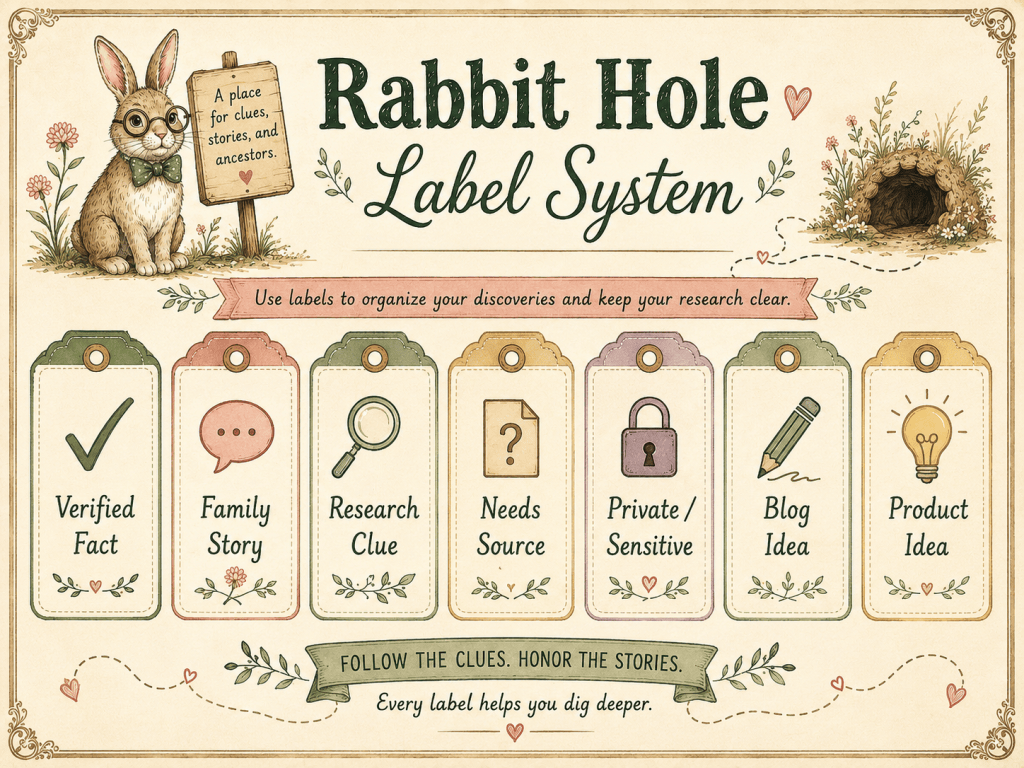
9. Fact, Family Story, or Research Clue?
Some rabbit holes are not facts yet.
Some are family memories. Some are theories. Some are clues. Some are suspicious little gremlins wearing a source citation hat.
A simple label can help.
Try using:
- Verified fact
- Family story
- Research clue
- Needs source
- Needs review
- Private / sensitive
- Blog idea
- Product idea
- Not for public sharing yet
This helps you separate:
- proven facts
- remembered stories
- unverified family traditions
- sensitive information
- research leads
- writing ideas
That distinction matters.
A family story can be valuable even before it is verified, but it should not be presented as proven if it is not. A parking lot label lets you preserve the clue without accidentally making it “family tree official.”
A very important distinction. Because once something becomes family tree official, it can spread like glitter.
And glitter is forever.
For help on how to conduct an interview, check out How to Conduct a Family History Interview Without Being Awkward.
What Should Go in the Rabbit Hole Parking Lot?
Here are the types of things worth parking.
Interesting Names
Park names that might matter but do not fit your current goal.
Examples:
- unfamiliar witness
- repeated neighbor surname
- possible maiden name
- possible sibling
- unknown child
- unexpected informant
- family friend
- person buried nearby
Suspicious Records
Park records that look interesting but need later review.
Examples:
- census household that might be related
- possible marriage record
- obituary with familiar names
- newspaper article
- land deed
- probate mention
- church entry
- military record
- cemetery plot clue
Places to Research Later
Park places that may matter.
Examples:
- county where family lived briefly
- town mentioned in obituary
- cemetery name
- church location
- school district
- migration stop
- old address
- courthouse or archive
Family Stories
Park stories that need follow-up.
Examples:
- “She was adopted.”
- “They changed the spelling.”
- “He ran away from home.”
- “There was a family feud.”
- “They came from Scotland.”
- “She was married before.”
- “He fought in a war.”
- “There was land somewhere.”
Family stories do not need to be dismissed.
They need to be labeled and investigated carefully.
Research Questions
Park questions that pop up while working.
Examples:
- “Why is this child missing in 1900?”
- “Who are these neighbors?”
- “Was this the same cemetery?”
- “Did the family move between census years?”
- “Is this John Sr. or John Jr.?”
- “Where did the parents go?”
- “Why does the birthplace change?”
For help with organizing your research, check out How Spreadsheets Can Help Your Genealogy Research.
What Should Not Go in the Parking Lot?
The parking lot is not for everything.
Try not to use it for:
- your main research log
- full source citations
- complete record transcriptions
- every single tiny thought
- long family stories
- finished conclusions
- private details without caution
- duplicate notes you already stored elsewhere
- anything urgent that belongs in your current research plan
If everything goes into the parking lot, the parking lot becomes the new chaos.
That is not the goal.
The parking lot is for side quests.
- Your research log is for actual searches.
- Your source tracker is for sources.
- Your timeline is for chronology.
- Your ancestor inventory is for one person’s research status.
- Your parking lot is for: “This might matter, but not right now.”
That boundary is what makes it useful.
How to Use the Parking Lot During Research
Here is a simple process.
- Start with one research goal.
- Keep your parking lot open nearby.
- When a side clue appears, pause.
- Write down the clue.
- Add where you found it.
- Add why it might matter.
- Add a follow-up question.
- Assign a priority if needed.
- Return to your original research goal.
- Review the parking lot later.
The important part is returning to your original goal.
Otherwise, the parking lot becomes a scenic rest stop where you accidentally move in.
Do not move in. You are parking. Not relocating.

When to Review Your Rabbit Hole Parking Lot
A parking lot only works if you review it occasionally.
Otherwise, it becomes a cute graveyard of abandoned ideas.
Not ideal.
Review it:
- after a research session
- once a week
- once a month
- before starting a new research day
- before writing a report
- before updating a family tree
- before planning a new printable
- whenever you feel stuck
- whenever makes sense for you
During review, ask:
- Is this still interesting?
- Does it connect to an active research question?
- Is it urgent?
- Can I add it to a research log?
- Should it become a timeline item?
- Does it belong in an ancestor inventory?
- Is it a family story to preserve?
- Can I archive it?
Not everything needs action.
Some parked clues can stay parked. Some can move into your research plan. Some can become “nope.”
“Nope” is a valid research outcome. A surprisingly freeing one.
How a Rabbit Hole Parking Lot Helps Future Research
A good parking lot becomes a future research idea bank.
It can help you:
- choose your next research question
- spot recurring surnames
- identify repeated places
- notice unsolved clues
- build timelines
- plan archive visits
- prepare interview questions
- create ancestor inventories
- write research reports
- avoid repeating old searches
- keep side quests from disappearing
Sometimes a clue that looked random at first becomes important later.
A neighbor’s surname shows up again. A witness turns out to be a brother-in-law. A newspaper clipping connects to a family migration. A family story matches a record. A parked idea becomes the missing link.
That is why you do not want to lose these clues.
You just do not want them taking over your afternoon without permission.
Common Rabbit Hole Parking Lot Mistakes
Mistake 1: Writing Too Little
“Check newspaper” is not enough.
Which newspaper? Which person? Which year? Why?
Future-you needs context.
Mistake 2: Never Reviewing It
A parking lot that never gets reviewed is just a prettier junk drawer.
Schedule a review.
Even a quick one.
Mistake 3: Parking Everything
Not every thought needs to be saved.
Some distractions can simply pass through.
If it does not connect to your research, your family story, or a future project, let it go.
Mistake 4: Chasing the Clue Anyway
Writing it down only works if you actually return to the main task.
The parking lot is not a permission slip to start researching the clue immediately.
It is a gentle “not today, little chaos goblin.”
Mistake 5: Not Recording the Source
A parked clue without a source is painful.
Always write where you found it. Even if it is messy.
Messy source note beats no source note. Every time.
A Simple Rabbit Hole Parking Lot Layout
A beginner-friendly Rabbit Hole Parking Lot can include:
- Date
- Interesting clue
- Where I found it
- Who or what it connects to
- Why it might matter
- Follow-up question
- Where to look next
- Priority
- Status
- Source or file link
- Notes
You do not have to use every field.
And honestly, simple is often better.
A parking lot you actually use is better than a complicated system you avoid because it looks like homework with decorative borders.
Quick Rabbit Hole Parking Lot Checklist
Before you move on, take a second and ask:
- Did I write the clue clearly?
- Did I record where I found it?
- Did I explain why it might matter?
- Did I add a follow-up question?
- Did I note where to look next?
- Did I label it as fact, story, clue, or idea?
- Did I mark priority or status?
- Did I return to my original research goal?
That last one is the whole point.
Park it. Focus. Solve. Revisit.
Repeat.
Final Thoughts
Rabbit holes are part of genealogy.
They are not always bad.
Some of the best discoveries come from noticing a strange clue, a repeated surname, a mystery witness, a suspicious neighbor, or one tiny detail everyone else ignored.
But if you chase every rabbit hole the moment it appears, your research can become scattered fast.
A Rabbit Hole Parking Lot gives those clues somewhere to wait.
It helps you stay focused without losing curiosity. It lets you protect your current research goal while still honoring the side quests that might matter later.
That is the balance.
Not “never chase rabbit holes.” Not “chase every rabbit immediately.”
Just:
- Park it for later.
- Focus now.
- Revisit with fresh eyes.
Because down the rabbit hole is fun.
But sometimes, we come back.

Related Rabbit Holes
If your genealogy side quests have been running unsupervised through your research notes, these posts may help:
- How to Organize Your Digital Files
- What to Include in a Genealogy Research Log
- How to Conduct a Family History Interview Without Being Awkward
- How to Make a Genealogy Timeline for Family History Research
- How Spreadsheets Can Help Your Genealogy Research
- 20 Types of Genealogy Records You’ll Find You Need
- The Antics Behind Multiple Generations WITH THE SAME NAMES
- 10 Things to Make Your Genealogy Research Easier

Sources & Further Reading
- FamilySearch Research Wiki — Research Logs
- FamilySearch — Research Logs: Part 1
- FamilySearch — Research Logs: Part 2
- FamilySearch Research Wiki — Genealogy Research Forms
- National Archives — Charts and Forms
- National Archives — Start Your Genealogy Research
- National Genealogical Society — Free Genealogy Resources
- Evidence Explained — QuickLesson 11: Identity Problems & the FAN Principle